ADI-2 Pro EX
Ultra-Fidelity PCM/DSD 768 kHz AD/DA Converter
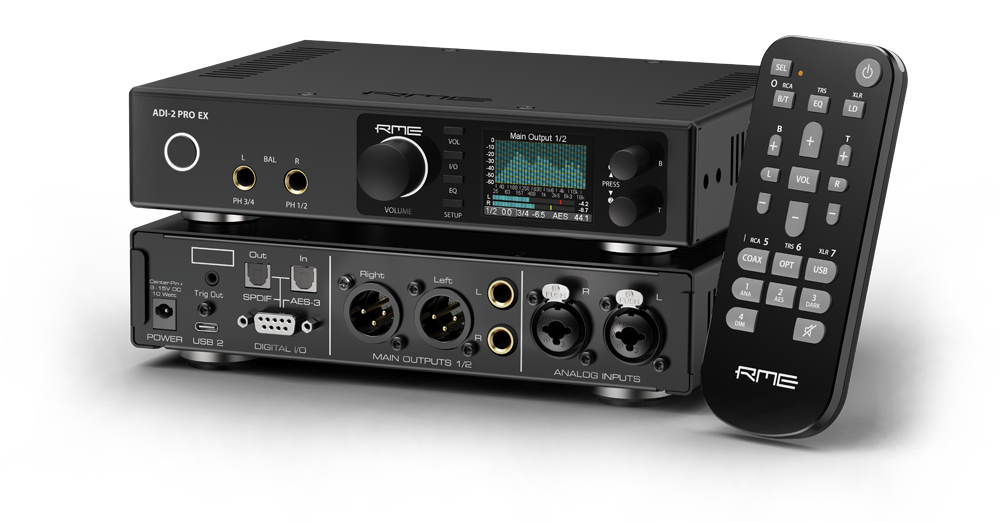
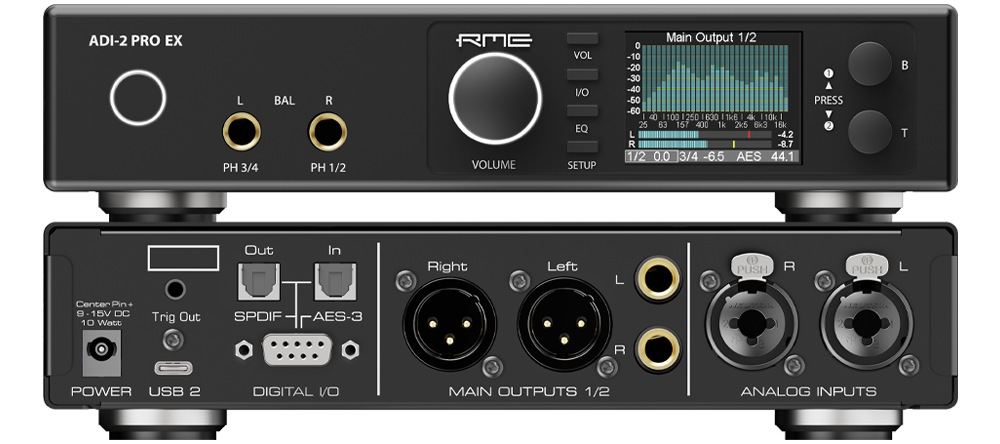
Connectivity and Features
1 x Stereo Analog I/O
1 x ADAT I/O
1 x SPDIF I/O
1 x AES I/O
RME USB-C
2 x Phones Output
Class Compliant Mode
Remote

SteadyClock EX
DC-coupled Outputs
Like the ADI-2 Pro, the ADI-2 Pro EX combines several devices in one: a high-end studio-quality AD/DA converter, a dual headphone amplifier, a multi-format converter (AES, SPDIF, ADAT) with monitoring features, a DSD recording and playback converter as well as an AD/DA frontend for audio measurements with up to 768 kHz sample frequency. With this range of functions, the new ADI-2 Pro EX presents itself as one of the most flexible converters on the market. The new ADI-2 Pro EX is equipped with the AK5574 analog-to-digital converter (ADC) and the AK4493 digital-to-analog converter (DAC).
What’s New in the EX Version
The EX version introduces substantial hardware and usability enhancements:
- Larger chassis with ventilation: Refined design and improved cooling efficiency, matching the ADI-2/4 Pro look.
- Upgraded with chrome feet from the ADI-2 DAC FS, adding a refined touch to the desktop setup.
- Lockable USB-C connection: Modern and robust (USB 2.0, no bus power), 1.8 m cable included.
- TS trigger output: Allows synchronized power control for external gear or amplifiers.
- Increased Phones output power in unbalanced and balanced mode.
- Channel-independent DC protection: New hardware circuit for maximum reliability.
- Advanced PSU protection: Fuse-less active circuitry detects and prevents wrong polarity and overvoltage conditions.
- Including lockable NT-RME-13: Light-weight, world-wide usable, universal power supply. Semi-grounded to prevent leakage current without ground-loop.
Ultra-fidelity PCM/DSD 768 kHz AD/DA Converter
As the most flexible converter available, the ADI-2 Pro EX offers balanced/unbalanced analog I/Os, double Extreme Power headphone outputs, SteadyClock FS, 4-stage hardware input and output level control, DSP-based signal processing, external power supply operation, Class Compliant USB compatibility, sample rates up to 768 kHz as well as DSD record and Direct DSD playback (256 / 11.2 MHz).
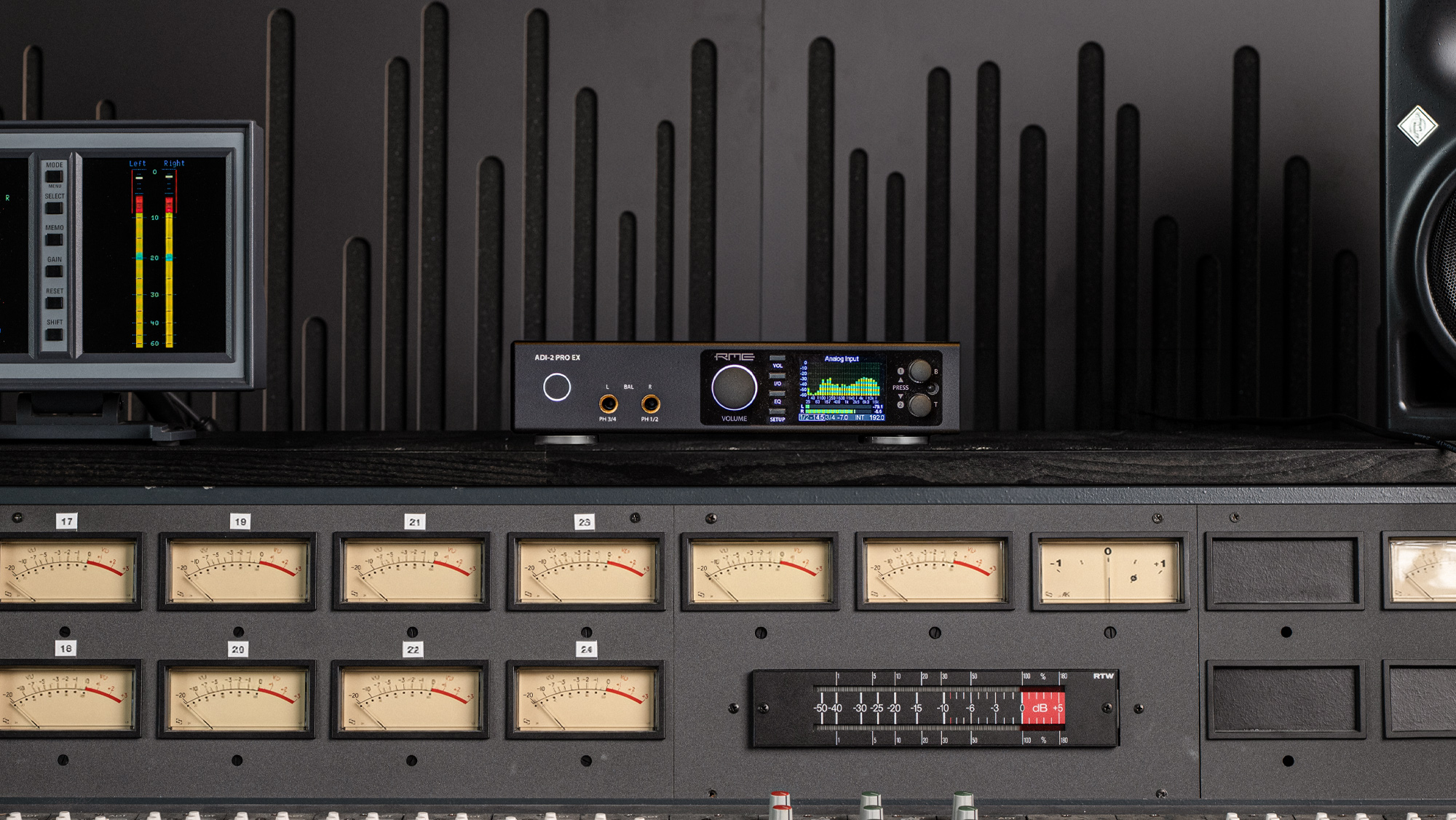
The outstanding choice for studio reference playback, professional mastering and audiophile listening environments
Analog or Digital - Options Galore
The ADI-2 Pro EX includes two servo-balanced analog inputs on combo XLR / TRS jacks, two separate balanced and unbalanced outputs on XLR and TRS, two stereo Extreme Power headphone outputs on the front, an optical SPDIF I/O that also understands ADAT, and coaxial SPDIF (RCA) and AES I/O (XLR) via an included breakout cable. This universal set of I/O options offers superior quality and flexible connectivity to those who take a no-compromise approach to audio.
The USB C port is fully Class Compliant (UAC 2) for connection with compatible iOS devices, and is also used for firmware updates. Including an external switched power supply with lockable connector, the ADI-2 Pro EX can be easily powered from battery, opening up mobile applications as well as galvanically isolated use cases.
As a computer interface the ADI-2 Pro EX offers a stereo (2 in / 2 out) and a multichannel mode (6 in / 8 out). Compatibility with macOS comes right out of the box. Under Windows the ADI-2 Pro EX uses RME's MADIface series driver, for full WDM and ASIO compatibility and highest performance.
The new Trigger Out socket provides a 12 V switching signal via 3.5 mm mono jack plug, which can be used e.g. to switch power amps with Trigger In on and off together with the ADI-2 Pro EX.
High Resolution Display Operation
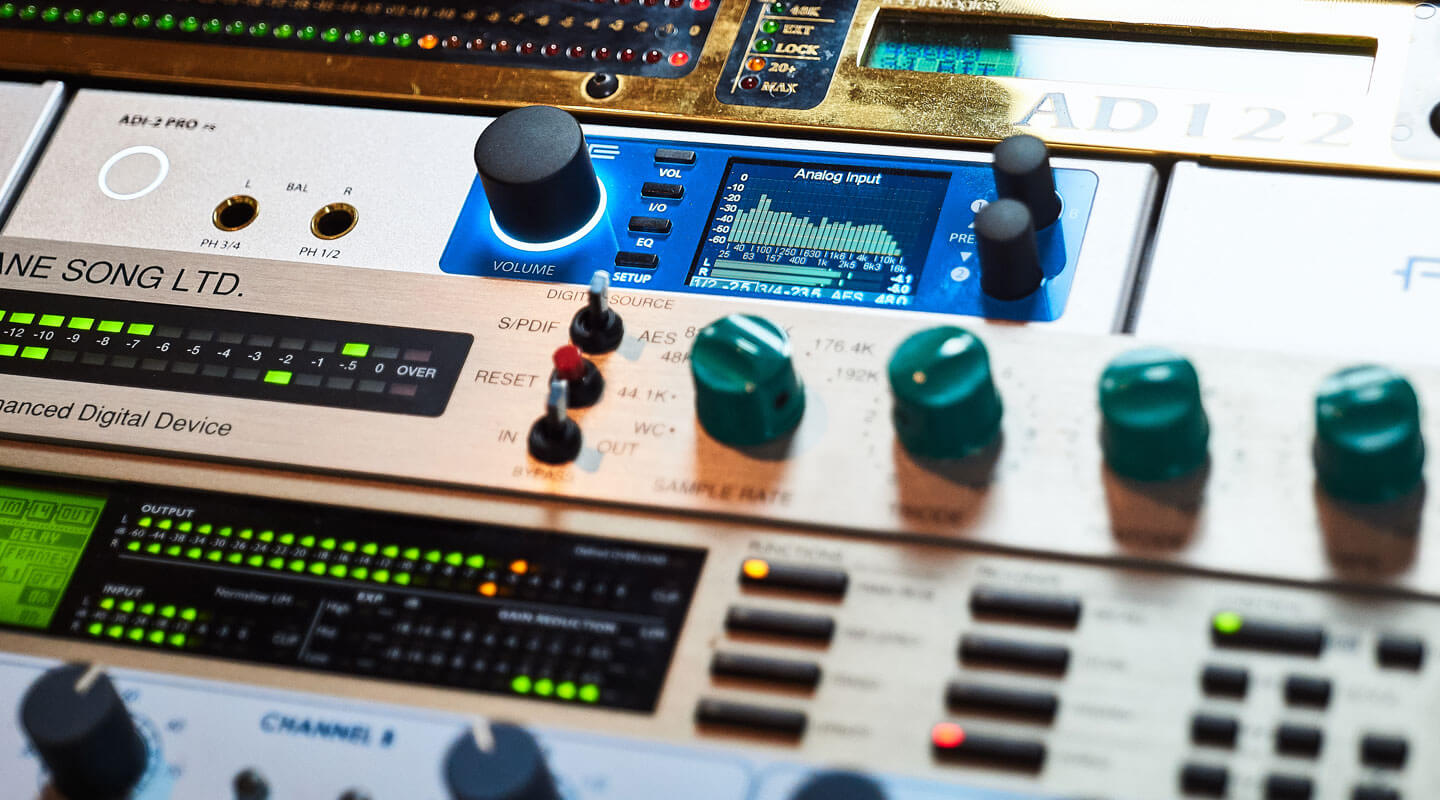
RME have incorporated many unique features, not found on any comparable devices, like 5-band parametric EQs for fully individual phones compensation, adjustable Bass/Treble controls with quick access, a binaural crossfeed function, adjustable loudness filter, selectable AD/DA filters, four discrete I/O reference levels, auto reference level setting, auto balanced phones mode, and many more. The display is not only used to control the unit, but also shows warning and guidance messages.
Professional features such as M/S Processing, stereo width and phase reversal up to full control and storage of all settings are included, as well as RME’s famous Spectral Analyzer, a 30-band biquad filtered analysis tool offering unprecedented musical visualization, perfectly complementing the high-resolution IPS display.
Extreme Power Headphone Outputs
RME further improved the Extreme Power headphone output stage to ensure the full performance of its premium DAC is available at the headphone outputs, including with demanding low-impedance headphones. The design delivers exceptionally clean, detailed sound while incorporating comprehensive protection and power management features. Dedicated low and high power modes ensure optimal performance across a wide range of headphone types.
For balanced headphone operation, RME created its proprietary Advanced Balanced mode, which goes beyond conventional balanced designs. It provides a direct balanced signal path from the DAC to the headphones, improving overall audio performance through enhanced signal quality, optimized frequency response, and greater consistency across components.
Precision Engineering Without Compromise
The ADI-2 Pro EX continues RME’s tradition of uncompromising converter design: stable clock architecture, ultra-linear analog stages and sonic transparency at the highest level.
Its numerous use cases make it an ideal choice in many fields, from the home user appreciating innovative solutions offering highest sound quality, the studio owner asking for reference AD/DA conversion, the Hi-Fi enthusiast demanding a flexible yet high-end headphone amplifier, up to the industry using the portable device as front-end for measurement systems.
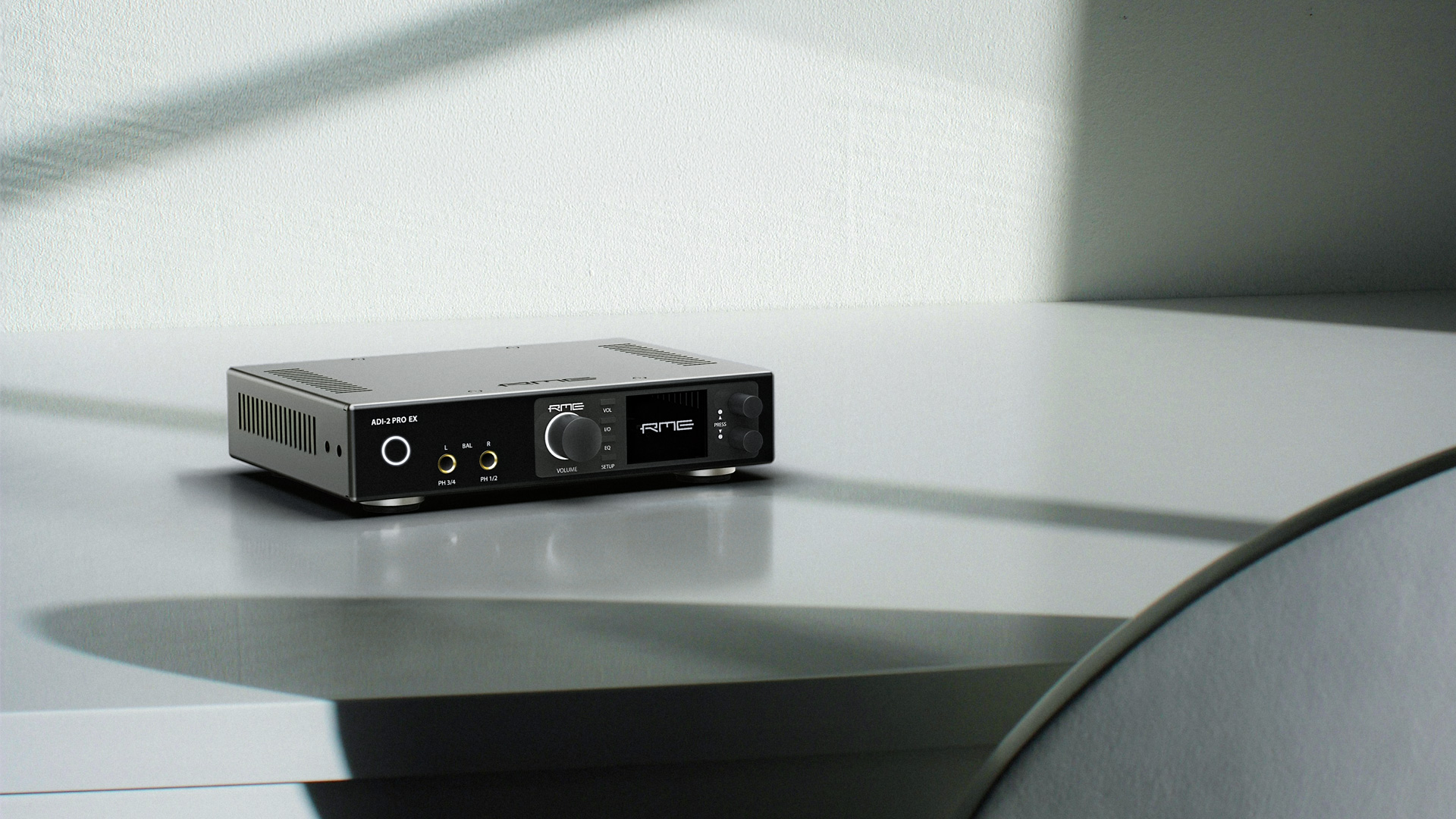
Refined design and improved cooling efficiency
More Outstanding Features
SteadyClock FS - Reference class Digital Clocking
Excellent performance in all clock modes and High Quality Analog Conversion to hear your mix as it is, with lowest jitter and highest jitter immunity.
ADI-2 Remote
The ADI-2 Remote software controller offers a seamless and intuitive interface for managing various parameters of the ADI- 2 series devices.
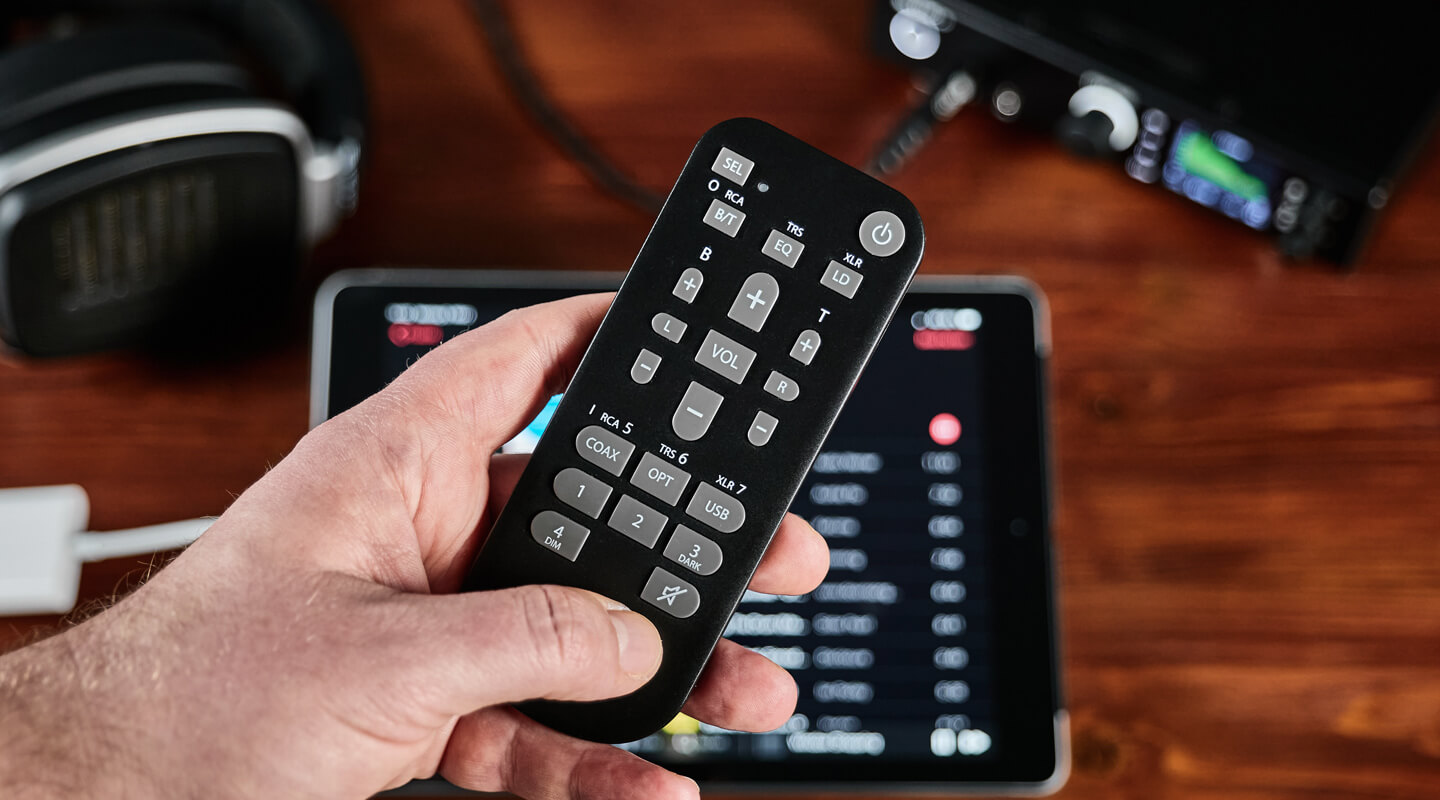
New extended Multi-Remote Support (MRC)
The ADI-2 Pro EX remote control provides buttons for standby on/off, volume, balance, bass and treble, input selection (optical, coaxial, USB), mute, on/off loudness, bass/treble and EQ. In addition, there are four programmable buttons that provide access to 61 different functions and commands for maximum flexibility. There is no other converter or comparable device with such a sophisticated, easy to use and at the same time versatile remote control!
Specs
ADI-2 Pro EX
Analog Inputs
XLR
- Input: XLR, servo-balanced
- Input impedance balanced: 18 kOhm, unbalanced: 9 kOhm
- Input sensitivity switchable +24 dBu, +19 dBu, +13 dBu, +4 dBu @ 0 dBFS
- Digital Trim Gain range: 0 dB up to +6 dB
- Signal to Noise ratio (SNR) @ +13/19/24 dBu: 120 dB RMS unweighted, 122 dBA
- Signal to Noise ratio (SNR) @ +4 dBu: 119 dB RMS unweighted, 122 dBA
- Frequency response @ 44.1 kHz, -0.1 dB: 5 Hz – 20.5 kHz
- Frequency response @ 96 kHz, -0.5 dB: 3 Hz – 45.5 kHz
- Frequency response @ 192 kHz, -1 dB: 2 Hz – 92.7 kHz
- Frequency response @ 384 kHz, -1 dB: < 1 Hz – 124 kHz
- Frequency response @ 768 kHz, -3 dB: < 1 Hz – 180 kHz
- THD @ -1 dBFS: -120 dB, 0.0001 %
- THD+N @ -1 dBFS: -116 dB, 0.00016 %
- THD @ -10 dBFS: < -140 dB, 0.00001 %
- Channel separation: > 110 dB
TRS
As input XLR, but:
- Input: 6.3 mm TRS jack, servo-balanced
Analog Outputs
1/2 XLR
- Output impedance: 200 Ohm
- Output level switchable +24 dBu, +19 dBu, +13 dBu, +4 dBu @ 0 dBFS
- Signal to Noise ratio (SNR) @ +13/19/24 dBu: 120 dB RMS unweighted, 123 dBA
- Signal to Noise ratio (SNR) @ +4 dBu: 117 dB RMS unweighted, 120 dBA
- Frequency response @ 44.1 kHz, -0.1 dB: 0 Hz – 20.2 kHz
- Frequency response @ 96 kHz, -0.5 dB: 0 Hz – 44.9 kHz
- Frequency response @ 192 kHz, -1 dB: 0 Hz – 88 kHz
- Frequency response @ 384 kHz, -1 dB: 0 Hz – 115 kHz
- Frequency response @ 768 kHz, -3 dB: 0 Hz – 109 kHz
- THD @ 0 dBFS: < -120 dB, 0.0001 %
- THD+N @ 0 dBFS: -115 dB, 0.00018 %
- Channel separation: > 110 dB
1/2 TRS (rear)
As output XLR, but:
- Output: 6.3 mm TRS jack, impedance balanced
- Maximum output level: +19 dBu
- Signal to Noise ratio (SNR) @ +19 dBu: 120 dB RMS unweighted, 123 dBA
- Signal to Noise ratio (SNR) @ +13 dBu: 118 dB RMS unweighted, 121 dBA
- Signal to Noise ratio (SNR) @ +4 dBu: 115 dB RMS unweighted, 118 dBA
- Output impedance: 100 Ohm unbalanced, 200 Ohm balanced
Phones 1/2
As Output 1/2 TS, but:
- Output: 6.3 mm TRS jack, unbalanced, stereo
- Output impedance: 0.1 Ohm
- Signal to Noise ratio (SNR) @ +22 dBu: 120 dB RMS unweighted, 123 dBA
- Signal to Noise ratio (SNR) @ +7 dBu: 118 dB RMS unweighted, 121 dBA
- Output level at 0 dBFS, Ref Level +19 dBu, load 100 Ohm or up: +22 dBu (10 V)
- Output level at 0 dBFS, Ref Level +4 dBu, load 8 Ohm or up: +7 dBu (1.73 V)
- THD @ +19 dBu, 32 Ohm load, 1.5 Watt: -122 dB, 0.000079 %
- THD+N @ +19 dBu, 32 Ohm load, 1.5 Watt: -115 dB, 0.00018 %
- Maximum output power @ 0.1% THD+N, 300 Ohm: 0,37 W per channel
- Maximum output power @ 0.1% THD+N, 32 Ohm: 1.9 W per channel
- Maximum output power @ 0.1% THD+N, 16 Ohm: 2.1 W per channel
- Channel separation 20 Hz - 20 kHz: 80 dB @ 32 Ohm
Output Phones 3/4
As Output Phones 1/2, but:
- Output levels at 0 dBFS: Hi-Power off +7 dBu, Hi-Power On +22 dBu
Balanced Phones mode
As before, but:
- Output impedance: 0.2 Ohm
- Output levels at 0 dBFS: Hi-Power off +13 dBu (3.46 V), Hi-Power On +28 dBu (19.5 V)
- Signal to Noise ratio (SNR) @ +28 dBu: 123 dB RMS unweighted, 126 dBA
- Signal to Noise ratio (SNR) @ +13 dBu: 121 dB RMS unweighted, 125 dBA
- Output level at 0 dBFS, Hi-Power On, load 150 Ohm or up: +28 dBu (19.5 V)
- Output level at 0 dBFS, Hi-Power Off, load 8 Ohm or up: +13 dBu (3.46 V)
- Maximum output power @ 0.1% THD+N, 300 Ohm: 1,4 W per channel
- Maximum output power @ 0.1% THD+N, 32 Ohm: 4.2 W per channel
- Maximum output power @ 0.1% THD+N, 16 Ohm: 2.7 W per channel
- Channel separation: > 130 dB @ 1 kHz
Digital Inputs
General
- Lock Range: 28 kHz – 200 kHz
- Jitter suppression: > 50 dB (> 1 Hz)
- Accepts Consumer and Professional format
AES/EBU
- 1 x XLR, transformer-balanced, galvanically isolated, according to AES3-1992
- Input sensitivity 0.3 Vpp
SPDIF coaxial
- 1 x RCA, transformer-balanced, according to IEC 60958
- High-sensitivity input stage (< 0.3 Vpp)
- AES/EBU compatible (AES3-1992)
SPDIF optical
- 1 x optical, according to IEC 60958
- ADAT compatible
Digital Outputs
AES/EBU
- 1 x XLR, transformer-balanced, galvanically isolated, according to AES3-1992
- Output level 2.9 Vpp
- Format Professional according to AES3-1992 Amendment 4
- Single Wire mode, sample rate 44 kHz up to 200 kHz
SPDIF coaxial
- 1 x RCA, according to IEC 60958
- Output level 0.75 Vpp
- Format Consumer SPDIF according to IEC 60958
- Single Wire mode, sample rate 44 kHz up to 200 kHz
SPDIF optical
- 1 x optical, according to IEC 60958
- Format Consumer (SPDIF) according to IEC 60958
- Sample rate 44 kHz up to 200 kHz
Digital
- Clocks: Internal, AES In, SPDIF In, ADAT In
- Jitter suppression of external clocks: > 50 dB (> 1 Hz)
- Effective clock jitter influence on AD and DA conversion: near zero
- PLL ensures zero dropout, even at more than 100 ns jitter
- Additional Digital Bitclock PLL for trouble-free varispeed ADAT operation
- Supported sample rates for external clocks: 32 kHz up to 200
- Internally supported sample rates: 44.1 kHz up to 768 kHz
General
- Included power supply: external switching PSU, 100 - 240 V AC, 2 A, 24 Watts
- Standby power consumption DC 12 V: 170 mW
- Standby power consumption AC 230 V: 280 mW
- Idle power consumption: 12 Watts, Max. power consumption: 24 Watts
- Idle current at 12 V: 1 A (12 Watts)
- Under voltage detection: < 8.8 V
- Over voltage disconnection: > 16.5 V
- Dimensions (WxHxD): 215 x 44 x 160 mm (8.5" x 1.73" x 6.3")
- Weight: 1.15 kg ( 2.5 lbs)
- Temperature range: +5° up to +50° Celsius (41° F up to 122°F)
- Relative humidity: < 75%, non condensing
All specifications are subject to change without notice.
Drivers
ADI-2 Pro EX
Remote, backup and editing app for the ADI-2 series for macOS, v 2.2. Requires latest firmware update!
Remote, backup and editing app for the ADI-2 series for Windows, v 2.2. Requires latest firmware update, and MADIface series USB driver 0.9827 or higher!
Remote, backup and editing app for the ADI-2 series for Windows, v 2.2. Requires latest firmware update, and MADIface series USB driver 0.9827 or higher!
Update to version: (*latest changes)
MADIface XT: USB 3/2 191, PCIe 56, DSP 42
MADIface XT II: USB 3/2 324, DSP 61, CC 15
MADIface USB, Hw Rev 6: 25, CC 4
MADIface USB, Hw Rev 7: 102, CC 103
MADIface Pro: 73
OctaMic XTC: USB 47, DSP 26
ADI-2/4 Pro SE (Hw Rev 6): FPGA 73, DSP 40
ADI-2/4 Pro SE (Hw Rev 7): FPGA 210, DSP 40
ADI-2/4 Pro EX: FPGA 324, DSP 106
ADI-2 Pro Series (Hw Rev 6): FPGA 270, DSP 130*
ADI-2 Pro EX (Hw Rev 7): FPGA 418, DSP 130*
ADI-2 DAC FS: FPGA 81, DSP 62
Digiface USB, Hw Rev X: 18, CC 2
Digiface USB, Hw Rev G: 35, CC 7
Fireface UFX II, Hw Rev A: USB 26, DSP 30, CC 15
Fireface UFX II, Hw Rev E: USB 115, DSP 30, CC 112
Fireface UFX II, Hw Rev 7: USB 206, DSP 30, CC 208
Fireface UFX III: USB 21 DSP 25 CC 47
Digiface Dante: 68 CC 21
Digiface Ravenna: 55 CC 3*
Digiface AES: USB 47, MCU 17, CC 11
USB I/O: USB 10 CC 14
USB.MADI: USB 18, CC 13*
Update to firmware: (* latest change)
MADIface XT: USB 191 PCIe 56 DSP 42
MADIface XT II: USB 3/2 323, DSP 61, CC 17
MADIface USB: 25 CC4 (6), 102 CC 103 (7)
MADIface Pro: 73
OctaMic XTC: 47/26
ADI-2 Pro series: FPGA 270, DSP 130*
ADI-2 Pro EX: FPGA 418, DSP 130
ADI-2 DAC series: FPGA 81, DSP 62
ADI-2/4 Pro SE (6): FPGA 73, DSP 40
ADI-2/4 Pro SE (7): FPGA 210, DSP 40
ADI-2/4 Pro EX: FPGA 324, DSP 106
UFX II: USB 26 DSP 30 CC 15 (A), USB 115 DSP 30 CC 112 (E), USB 206 DSP 30 CC 208 (7)
Fireface UFX III: USB 21 DSP 25 CC 47
UFX+: USB 55 DSP 62 Thunderbolt 112 (A), USB 72 DSP 62 Thunderbolt 167 (E)
Digiface USB: 18 CC 2 (X), 35 CC 7 (G)
Digiface AVB: 273*
Digiface Dante: 68 CC 21
Digiface Ravenna: 55
Digiface AES: USB 47 MCU 17 CC 11
USB I/O: USB 10, CC 14
USB.MADI: USB 18, CC 13*
Update to version: (*latest changes)
MADIface XT: USB 3/2 191, PCIe 56, DSP 42
MADIface XT II: USB 3/2 324, DSP 61, CC 15
MADIface USB, Hw Rev 6: 25, CC 4
MADIface USB, Hw Rev 7: 102, CC 103
MADIface Pro: 73
OctaMic XTC: USB 47, DSP 26
ADI-2/4 Pro SE (Hw Rev 6): FPGA 73, DSP 40
ADI-2/4 Pro SE (Hw Rev 7): FPGA 210, DSP 40
ADI-2/4 Pro EX: FPGA 324, DSP 106
ADI-2 Pro Series (Hw Rev 6): FPGA 270, DSP 130*
ADI-2 Pro EX (Hw Rev 7): FPGA 418, DSP 130*
ADI-2 DAC FS: FPGA 81, DSP 62
Digiface USB, Hw Rev X: 18, CC 2
Digiface USB, Hw Rev G: 35, CC 7
Fireface UFX II, Hw Rev A: USB 26, DSP 30, CC 15
Fireface UFX II, Hw Rev E: USB 115, DSP 30, CC 112
Fireface UFX II, Hw Rev 7: USB 206, DSP 30, CC 208
Fireface UFX III: USB 21 DSP 25 CC 47
Digiface Dante: 68 CC 21
Digiface Ravenna: 55 CC 3*
Digiface AES: USB 47, MCU 17, CC 11
USB I/O: USB 10 CC 14
USB.MADI: USB 18, CC 13*
Update to firmware: (* latest change)
MADIface XT: USB 191 PCIe 56 DSP 42
MADIface XT II: USB 3/2 323, DSP 61, CC 17
MADIface USB: 25 CC4 (6), 102 CC 103 (7)
MADIface Pro: 73
OctaMic XTC: 47/26
ADI-2 Pro series: FPGA 270, DSP 130*
ADI-2 Pro EX: FPGA 418, DSP 130
ADI-2 DAC series: FPGA 81, DSP 62
ADI-2/4 Pro SE (6): FPGA 73, DSP 40
ADI-2/4 Pro SE (7): FPGA 210, DSP 40
ADI-2/4 Pro EX: FPGA 324, DSP 106
UFX II: USB 26 DSP 30 CC 15 (A), USB 115 DSP 30 CC 112 (E), USB 206 DSP 30 CC 208 (7)
Fireface UFX III: USB 21 DSP 25 CC 47
UFX+: USB 55 DSP 62 Thunderbolt 112 (A), USB 72 DSP 62 Thunderbolt 167 (E)
Digiface USB: 18 CC 2 (X), 35 CC 7 (G)
Digiface AVB: 273*
Digiface Dante: 68 CC 21
Digiface Ravenna: 55
Digiface AES: USB 47 MCU 17 CC 11
USB I/O: USB 10, CC 14
USB.MADI: USB 18, CC 13*
Driver for Windows 10 / 11, Intel x64 and Arm, version 1.0.26. Supports Intel Windows 10 or up 64 bit, and Windows 11 Arm systems, with both WDM and ASIO. Updated installer. See readme for details.
Driver for Windows 10 / 11, Intel x64 and Arm, version 1.0.26. Supports Intel Windows 10 or up 64 bit, and Windows 11 Arm systems, with both WDM and ASIO. Updated installer. See readme for details.
Universal binary, runs natively on Intel and Mx machines. DigiCheck NG V 0.93 requires macOS 10.13 (High Sierra) or up.
Differences to v 4.53: EBU R-128 Meter. Surround Audio Scope with ITU weighting. Simultaneous usage of multiple cards in all functions. Displays fully configurable (e.g. channel selection). Multichannel Level Meter freely configurable. MMCSS for Vista. Many improvements on surface and internal operation. Supports all current interfaces plus DIGI 9636/52. DIGI32 series and DIGI96 series are no longer supported. (10/05/2020).
V596 adds compatibilty for HDSPe MADI FX and XT with DK firmware.
DigiCheck NG V 0.93 requires a Direct3D 12 capable graphics card and Windows 10 or up.
DigiCheck NG V 0.93 requires a Direct3D 12 capable graphics card and Windows 10 or up.
Manuals
ADI-2 Pro EX
ADI-2 Remote manual, version 2.2, 07/2026